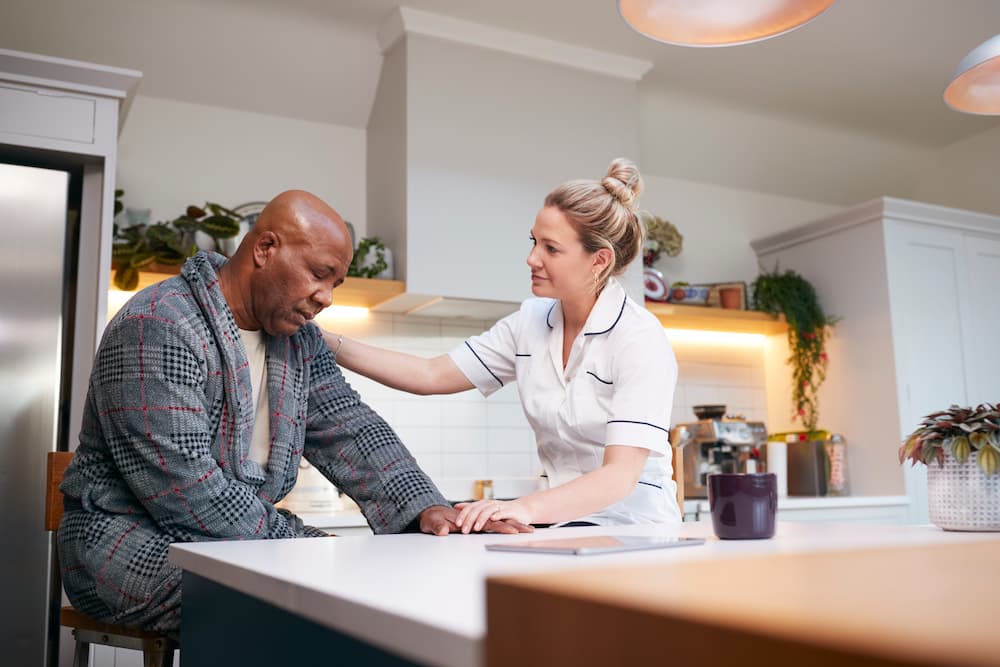
The example below is illustrative. It is drawn from the kind of packages we run every week, with details combined and altered so that no individual can be identified.
A discharge coordinator rang us on a Thursday afternoon about a gentleman in Aintree who was going home the following Monday. He had been on a ward for eleven days after a fall at home. He lived alone; he had every intention of carrying on living alone, and his daughter in Manchester was quietly panicking about it. We had carers through his door by Monday teatime.
The call we got
He had been marked medically fit for discharge. That is not the same thing as ready to be at home. He could manage short distances with a frame, but he was not confident on the stairs; he could not get in and out of the bath safely, and he had lost weight on the ward because meals arrived at times that did not suit him.
His daughter had two hours in the car between her and her dad. She was the one asking the questions. Would he eat? Would anyone notice if he had another fall? Was he going to end up straight back in hospital?
Those are the right questions. Readmission after a fall is a real risk, and the first fortnight home is where most of it sits. It is also why we treat arranging home care quickly after a fall or hospital stay as a different job from a planned package with six weeks of notice.
What we put in place
Four calls a day for the first two weeks, all of it visiting home care rather than a residential move.
Morning, 8 am, 45 minutes. Getting up, a strip wash at the basin rather than the bath, dressing, and a proper breakfast made and eaten with the carer there. Medication prompt.
Lunchtime, 12.30 pm, 30 minutes. Hot meal, drinks left within reach, a quick look around for trip hazards. This is also where we noticed he was skipping his afternoon fluids.
Teatime, 5 pm, 30 minutes. Meal, medication prompt, washing up, bins.
Evening, 9 pm, 30 minutes. Settling for the night, downstairs to bed with support on the stairs and phone and light left where he could reach them.
The same two carers covered the whole rota between them. That mattered more than anything else on the list. A man who has just come out of hospital does not want to explain where the tea bags are to a different face every day.
We also had a care log in place so his daughter could see each visit from her phone. She stopped ringing him at 9.15 pm to check. If you are the family member two hours down the M62, our guide to monitoring home care when you live miles away covers what to ask a provider for.
What the first six weeks looked like
Week one was the heaviest. He was tired, a little low, and not steady.
By week three he was making his own breakfast, so the morning call dropped to 30 minutes and became support with washing and dressing only. The lunchtime call came out altogether in week four once he was eating properly and moving around the kitchen with confidence.
By week six, he was on two calls a day, morning and evening. He has stayed on that. He has not been readmitted.
Reducing the package is the point. Good home care after a discharge should get smaller over time, not bigger, and a provider who never suggests stepping down is not paying attention.
Why this works
Continuity of carer. Two carers, not twelve. They spot the change in appetite, the new bruise, the fact that he has stopped going in the front room. A rotating cast does not. It is the first thing we would tell anyone choosing a home care provider in Liverpool to ask about.
Timings built around him, not the rota. His tea is at five because that is when he has always eaten. We build the call times around the person and then staff to them.
One line of communication for the family. His daughter knew what had happened at each visit without the need to interrogate her dad about it. That is often what helps a family feel relaxed.
If you are arranging care after a discharge
You do not need to wait for the discharge date. The best time to ring us is when the ward first starts talking about going home, because it gives us time to visit, write the care plan and get the right carers allocated.
How fast can we start? Within 72 hours for private clients. Often sooner if the situation calls for it.
What it costs. £28 an hour, weekends included at the same rate. The minimum visit is 30 minutes, so a 30-minute call is £14. There is more on rates and what drives them in our guide to how much home care costs per hour.
What is included. Personal care, meal preparation, medication prompting, shopping, laundry and light domestic work. The full list is set out in what private home care includes.
How it was paid for. This package was self-funded. He owned his home and his savings sat above the means-test threshold set out in the Care Act 2014, so the local authority would not have funded it. Plenty of our clients are in the same position, and plenty of others choose private home care even when they would qualify for support, because it gives them a say over who comes and when. Our guide to private home care funding covers the routes in more detail.
Quarry Homecare is registered with the Care Quality Commission to provide personal care, and we have more than 16 years in the domiciliary care sector across Liverpool and Merseyside.
Common questions
How quickly can care start after a hospital discharge?
Within 72 hours for private clients. We carry out an assessment first, usually at home or on the ward, and we write the care plan around the discharge summary and what the person actually wants.
Do we still get the free NHS care after hospital?
Some people are offered a period of free intermediate care or reablement after a hospital stay, arranged through the hospital or the local authority. It is not automatic, it is time-limited, and it is not always enough on its own. A number of our clients run a private package alongside it, or pick up when it ends. There is more on how the two sit together in our guide to private and NHS home care.
Can we set it up before the discharge date?
Yes, and we would rather you did. Ring us as soon as a discharge is being discussed.
Do you offer live-in care?
No. We provide visiting home care across Liverpool and Merseyside, from 30-minute calls upwards.
Coming home should not be the frightening part. If someone in your family has been discharged from hospital, call us on [phone number] or use our contact page and we will talk through what a package would look like.
We cover Aintree, Fazakerley and the surrounding areas, including home care in Walton and home care in Croxteth. See all of our Liverpool locations.